
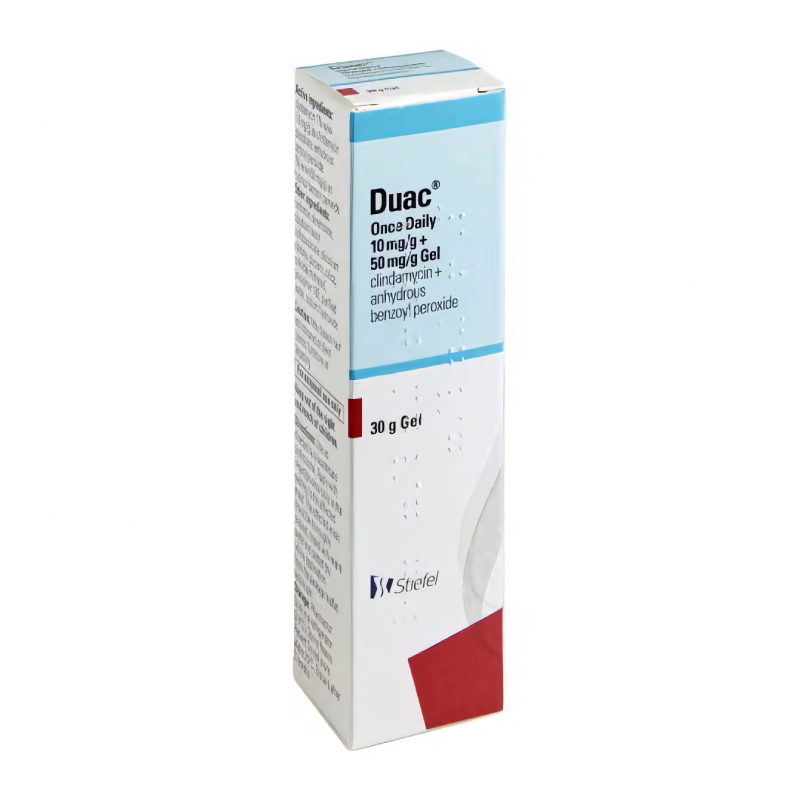
Duac Gel
You will answer clinical questions before treatment is considered. Submitting a consultation does not guarantee supply.
Duac Once Daily Gel is a prescription acne treatment applied directly to the skin. It contains two active ingredients: clindamycin and benzoyl peroxide.
Duac may be suitable for mild to moderate acne, particularly where acne is inflamed, red, raised or spotty. It may help with inflammatory acne lesions such as papules and pustules, as well as acne involving blocked pores, blackheads and whiteheads.
How to use
Use Duac exactly as directed by your pharmacist, prescriber or the patient information leaflet supplied with your medicine.
Duac is for external skin use only. It is usually applied once daily in the evening to the acne-affected area, where suitable.
Before applying Duac, wash the affected skin gently with a mild cleanser and dry fully. Apply a thin film of gel to the entire affected area, not just individual spots. If the gel does not rub in easily, too much may have been applied.
Wash your hands after applying the gel.
Avoid contact with the eyes, lips, mouth, nostrils, mucous membranes, broken skin, irritated skin and very sensitive areas. If accidental contact occurs, rinse well with water.
Do not apply more than directed. Using more gel will not improve results faster and may increase redness, peeling, dryness, burning and irritation.
During the first few weeks, peeling, redness, dryness or mild irritation may occur. A non-comedogenic moisturiser may help. If irritation becomes troublesome, your clinician may advise reducing frequency temporarily, pausing treatment or stopping treatment.
Avoid excessive sunlight, sunbeds and UV lamps while using Duac. Use suitable sun protection when sun exposure cannot be avoided.
Duac can bleach hair, towels, bedding, clothing and coloured fabrics. Allow the gel to dry fully before contact with fabrics.
Do not use Duac continuously for more than 12 weeks unless specifically advised after clinical review. Acne antibiotic treatment should be reviewed to reduce unnecessary antibiotic exposure and resistance risk.
If acne does not improve, worsens, becomes painful or cystic, causes scarring, or significantly affects mood or confidence, seek clinical review.
Main Ingredients
Duac Once Daily 10mg/g + 50mg/g Gel contains two active ingredients:
Clindamycin 10mg per gram as clindamycin phosphate.
Benzoyl peroxide 50mg per gram as hydrous benzoyl peroxide, equivalent to anhydrous benzoyl peroxide 5% w/w.
Other ingredients include carbomer, dimeticone, disodium lauryl sulfosuccinate, edetate disodium, glycerol, silica colloidal hydrated, poloxamer 182, purified water and sodium hydroxide.
Duac is a white to slightly yellow gel.
If you stock Duac Once Daily 10mg/g + 30mg/g Gel instead, the benzoyl peroxide strength should be amended to 30mg/g, equivalent to 3% w/w.
Always read the patient information leaflet supplied with your specific medicine before use.
Side Effects & Cautions
Some people experience side effects while using Duac. Very common side effects can include redness, peeling and dryness at the application site. These are usually mild but can be more noticeable when treatment is first started.
Common side effects can include burning sensation at the application site.
Uncommon side effects can include tingling, dermatitis, itching, rash and worsening of acne.
Other reported side effects include allergic reactions, hives, skin discolouration, application-site reactions, diarrhoea, abdominal pain and colitis, including antibiotic-associated colitis.
Stop using Duac and seek urgent medical advice if you develop swelling of the face, lips, tongue or throat, difficulty breathing, severe rash, hives, faintness, collapse or symptoms of a serious allergic reaction.
Stop using Duac and seek medical advice promptly if you develop prolonged or severe diarrhoea, abdominal cramps or blood/mucus in stools. Although Duac is applied to the skin, clindamycin can rarely be associated with antibiotic-related bowel inflammation.
Duac is not suitable for everyone. Do not use it if you are allergic to clindamycin, lincomycin, benzoyl peroxide or any ingredient in the gel.
Extra clinical review may be needed if you have very sensitive skin, eczema, atopic skin, broken skin, sunburn, severe acne, cystic acne, acne scarring, inflammatory bowel disease, ulcerative colitis, Crohn’s disease or a history of antibiotic-associated colitis.
Do not use Duac with other topical acne treatments, retinoids, benzoyl peroxide products, exfoliating acids, medicated cleansers, abrasive scrubs or strongly drying skincare products unless advised by a clinician, as irritation may increase.
Duac should not usually be used at the same time as erythromycin-containing products. Tell your clinician about all acne treatments, skincare products and medicines you use.
If you are pregnant, planning pregnancy or breastfeeding, Duac should only be used where clinically appropriate after individual risk-benefit assessment. If used during breastfeeding, it should not be applied to the breast area to avoid accidental infant exposure.
Suitability depends on acne type, acne severity, affected areas, previous treatments, skin sensitivity, medical history, current medicines, pregnancy or breastfeeding status, allergy history and clinical assessment. Prescription medicine is supplied only where clinically appropriate.
Read the official patient information leaflet before using any medicine. The leaflet provides important information on use, cautions, side effects and storage.
Open leaflet on eMC